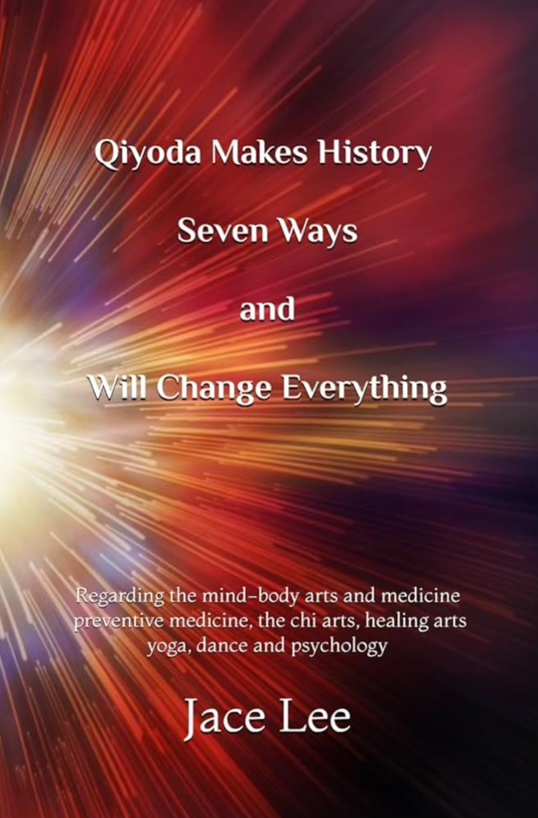
This is an unprecedented work on the subject of chi. No other book in existence sets out to prove the existence of chi in a way that everyone can experience it now and modern medicine can study and use it. This book proves that chi runs along the nerves and by this understanding means that by placing one’s awareness on the body and that feeling of awareness is chi. Through the concepts of connected awareness and passive awareness we find a difference in body awareness. Passive awareness is what we experience as feeling what the body is sensing, like clothes and our environment. Connected awareness is the act of sensing our body with our mind to feel it. There is a definite difference in the feeling of connecting to the body. This awareness grows as you focus more and when you move that awareness around, it feels like energy. This is chi. And this gets proven by comparing the works of the top masters who were willing to share this information in a book. Of which there are only three others on the market today.
One master teaches, one only wrote a book and doesn’t teach and the other teaches but learned their technique from outside the world of chi cultivation.
This book also shows the similarities of the principles of moving chi developed by people from different times and cultures who all reached the same or similar conclusions in the cultivation of energy (chi) and its use for healing and well-being. This simple piece of information, these principles and this book has the potential to change all internal arts and mind-body arts in the world.
For example, today about 98% of the arts of chi cultivation that are practiced today cultivate and use chi in a passive way. As in, moving the body, breathing and meditation to affect chi. Using needles to affect chi. As opposed to cultivating and using chi directly, as in, moving chi with the mind, feeling it move and using it to affect the body. This is neigong in internal arts terms. When this information is assimilated by all practitioners of the internal arts, the percentage ratio will flip. Meaning that 98% of people practicing an art of chi cultivation will now be cultivating chi directly and only 2% will be practicing qigong.
And being that now modern medicine can know where mind and body meet and how to cultivate that connection and its connection to chi, and that now chi can be experienced immediately with consistent results, means that now science can study and use it. This combined with the principles of chi cultivation, breathing, relaxation, connection to mind and chi and body, visualization, meditation and alignment, can bring new perspectives and approach to mind-body and preventive medicines and healing.
This work looks at the top books and the teachings of the top masters in the world teaching arts of chi cultivation also known as the internal arts. These are qigong, neigong, taichi, baguazhang, hsing I and yoga. This book gives detailed descriptions of the “three treasures,” jing, Qi (chi), and shen, and the experiences of each. Then you will find detailed definitions of their counterpart arts. Qigong for jing, neigong for chi and shengong for shen. This book also sheds light on the higher techniques of chi cultivation and how they work. Which no other book does. Another thing this book sets out to do is to create a standard for the different types of chi and their arts. Today people’s descriptions of the different arts very confusing and never seem to be able to clearly differentiate between qigong and neigong and shengong. This book also looks at the reasons why this information has been lost for so long and how it is still lost today.
The purpose of this book is not to tout Qiyoda’s successes. It is to prove its merit and the merit of all other arts that are chi and mind-body related. It is to prove to science and medicine that chi exists, and how it can be studied and used. The main purpose of this book is to show how this information will change everything related to chi and the mind and the possibilities and potential for the good that this information can have in the world.
“The mind–body problem is really two problems. The item problem concerns the nature of mental items: are they or are they not physical? The essence problem concerns the nature of the defining essences of mental phenomena – consciousness and intentionality: can they or can they not be explained in physical terms. With regard to the item problem consensus gradually seems to be coalescing on a combination of (1) mental–physical identity at the level of tokens, (2) mental–physical supervenience at the level of types, where this supervenience is underwritten by (3) a functionalist account of the nature of mental properties.”
“The mind-body problem is the problem of understanding what the relation between the mind and body is, or more precisely, whether mental phenomena are a subset of physical phenomena or not.”
THE MIND-BODY PROBLEM by: Matthew Van Cleave
Introduction: A pathway through this chapter, Introduction to Philosophy
“the hard problem.” For dualists, the mind-body problem manifests itself as “the interaction problem”—the problem of explaining how nonphysical mental phenomena relate to or interact with physical phenomena, such as brain processes.”
Solving the mind body problem and how it relates to Chi
This mind-body relationship view has long posed a problem for many scholars as it dictates that the mind and the body are separate and not responsible for the other. Thus, the lack of a clearly identifiable meeting point between the intangible mind and the physical body has shown to be challenging to dualism. No longer is this a Challenge.
This is a very plausible solution based on years of research, practice and direct experience. When I think about the mind-body problem it seems to be a matter of the separation of mind and body, the relationship between the two and what is the mind made of if it is not physical. Also, when there is no brain function, the mind does not seem to exist.
In my experience working with the mind to affect my body I find that there is a clear separation of the two. Even though the mind is continuously aware of the whole body, the conscious awareness of it really only falls to a small area of the body. The matter of how integrated the mind is into the body, is a matter of the individual. This can be a natural full integration or it can take work. And when it comes to what the mind is made of, I can only offer the concept of Chi. But what is Chi, exactly? This is where it gets complex because I can only describe my experience of it. I can however get others to experience Chi themselves and to experience my Chi as well.
To give Chi a name that might elicit a better idea of what it is, I would call it mind energy. This is why. When I focus on a part of my body, the size of awareness being the size of my palm, I can feel a difference in awareness from my normal awareness. I call this connected awareness because I feel much more connected to my body, where my mind is focused. In turn that area becomes more responsive to my thoughts. Where this feeling starts to feel like energy is when I move it -the awareness- around my body. Also, when I imagine that feeling moving like water or wind through an arm, I feel what I am imagining. This certainly gives the impression of energy and how energy, in a non-solid form, moves.
The real question; is Chi and mind one thing or are they separate? The Mind-energy problem? This has been the tough question for me. For one, Chi seems to be more than just mind energy. Chi is also in all things living. It has its own program to promote growth, life and healing. One explanation, from Taoism, describes the mind energy as an energy body or Chi body. Technically speaking this makes sense, if this mind energy feels like energy and it is related to my awareness, then it must be in the shape of my body because my body is filled with Chi. But by force of will I can visualize Chi to do any number of things to affect my body and others. Which technically would take it out of the body shape. So therefore, there must be some measure of Chi, or lifeforce energy that remains in the body where the direct awareness is not. Which begs the question, what Chi is mind using to feel the body and manipulate it on a physical level? This is what mind energy is. It is an energy in the body that the mind interacts with directly to affect the body. There are also other forms of Chi that can be cultivated and used. In a way Chi is a general term for spiritual energy because Chi has many aspects. When considering the mind body problem, there is a clear separation between mind and body.
The question still remains, if Chi and mind are separate then what is mind made out of?
In my experience, there is us, the root consciousness, the observer. Then there is the mind, and then there is Chi (mind energy) and the body, which has its own energy. The consciousness can observe the mind and control it. I can have two distinct thought patterns between the two. My mind can be thinking of something and I can also be thinking of something else. But I can only really focus on one or the other. Focusing on two things at once is doable but not easy. Like chanting two different mantras in my head at once. I get one going and then start the other one.
Unfortunately, the mind can also control the observer. But by what means does the consciousness observe the body. We know that we have our senses but we need a way to interact with it and move it. The nervous system. Through chemical and electrical impulses, we can feel and move the body via awareness and however our consciousness desires. These impulses can be voluntarily manipulated because our body is wired to reflect the will of the observer.
Here is the thing, when we merge mind and observer, this is described as focused and can be classified as meditation. Then when these are merged with the body, not necessarily as a whole, this can be considered the melding of mind, body and spirit. This is the very noticeable feeling I described as connected awareness.
There is the question, if a person is brain dead, there is no evidence of mind. I think of it like this, let’s say you are driving your car. As you are driving the cars computer stops working. Suddenly the car is no longer responsive to the driver’s input. The driver is fine but the car can no longer function. You manage to stop and get out but the car can still keep running because it still has fuel but it won’t shut down because the computer is broken. Since the brain is broken, it can no longer function and the conscious observer’s input no longer works. The scary question is, when the brain can no longer respond to the consciousness, did the observer manage to get out?
This leads to the question, is the mind relegated to only existing in the brain? Spiritual practice and experience say no. In meditation while concentrating on connecting to an area in my body in order to release tension, I had the experience of my mind/awareness moving. Suddenly, as I focused, I felt as if I was much closer to area of my focus. Now, was my mind still inside my head? Technically yes, but it seemed as if I had moved to a realm past the physical. It was kind of like being in a room then turning the lights off, there was no more sensory input to tell me where the walls ended. In the Yoga tradition, meditation is meant to lead to samadhi, this is when observer and observed become one. This can give the experience that the individual’s consciousness has moved into the object or person of their focus. Then there is the matter of out of body experience. I have met a few people with this ability. So, it seems that the conscious observer can move out of the head and out of the body. This certainly raises a couple of questions. Does the mind come with the observer? Or is the mind separate of the observer? Well, we know that when the individual is focused, mind and observer are one, and going out of body takes focus. So, in theory, mind and observer are one. They can become detached in the same manner as people from their body.
I think it boils down to voluntary and involuntary functions of the body. Our bodies can function without the mind. But with the mind these functions can be taken over. This ability that we have to be aware of and control the body is the key. The body is built to respond to the mind and the mind to the observer. I see Chi as a bridge between mind and body, like an interface. Like the saying goes, “mind moves Chi and Chi moves the body.”
This is a good explanation but does it solve the mind-body problem? We have a clear separation of observer, mind, Chi and the body. But at the same time, we can merge them all into one experience. But the question that remains is what are Chi and mind made of? I can only posit that mind is made of Chi. If we can move that awareness around the body and observe it somehow by mechanical means then this could be a breakthrough. But even if we could identify what is happening in the body chemically when Chi is moved, this is just the observation of an effect the Chi is having and not the Chi itself.
Electricity is still an unknown substance. We know how it exists and how to cultivate it and harness it, we can experience it but yet it is different from the particles that exist with it. At least with Chi/mind-energy, we can do the same.
Mind, body and Chi can function on their own, it is the observer that can control them. Maybe we should be asking, what is the observer made out of? That is another article, but there is one thing about Chi that is going to probably create more questions. My next question is, if it is an immaterial substance, how is it that I can move it into another person and they can sense it physically and there are visible physical effects in the body? This means that my mind can affect anything that has Chi.
There we are, the mind and body are separate or at least appear to be. It just takes a lot of concentration to move it from the head center of the body. The reality is that we can postulate all we want but as we can see Chi is a substance that is experienced by everyone physically through our awareness of ourselves and our ability to manipulate our body on a conscious willful level. What we need to be aware of most of all is the existence of and relationship between the three. In a way this proves the connection between mind and Chi and how the conscious observer affects all three. It is funny, the saying of connecting mind, body and spirit. Mind and spirit are already connected, it is mostly about melding mind, body and observer. This is part of the path to mastery. Becoming aware of all three, integrating them with total awareness and with only a thought, they all react as one.
The question of what consciousness is and what is it made of can only be answered by the turning off of the senses and thought. What is consciousness without the internal dialogue and imagery and physical/sensory awareness? Is there still awareness and if there is what is it like?


 Innerverse